


MS Square Pipes vs MS Square Tubes: The Structural Difference

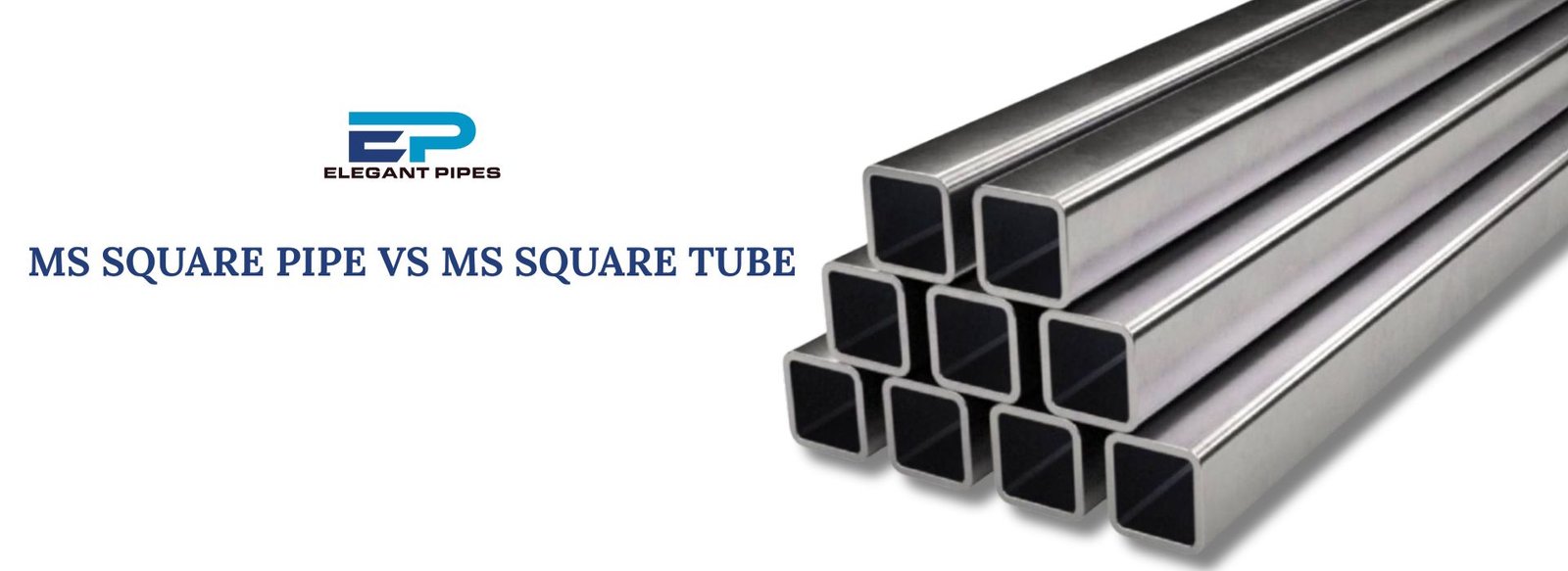
In many industrial projects, MS square pipes and MS square tubes are often assumed to be the same, simply because they look similar. This confusion can create problems during construction or fabrication, especially in large projects meant for export or heavy structural use.
For buyers, engineers, and contractors, it is important to understand that MS square pipes and MS square tubes are made for different uses. Even though both are made from mild steel, they follow different manufacturing standards and behave differently when used in structures or fabrication work.
This guide by Elegant Pipes, a reliable MS square pipe manufacturer in India and global exporter, explains these differences in a clear and practical way. It helps buyers understand sizing, strength, applications, and how to choose the right product for their project.
Understanding MS Square Pipes
MS square pipe are hollow structural sections primarily used where strength, rigidity, and load-bearing capacity are required. Although the term “pipe” is traditionally associated with fluid flow, in the case of square profiles, MS square pipes are widely used in structural frameworks rather than fluid transport.
They are typically produced for heavy-duty applications where exact dimensional precision is less critical than overall structural performance.
Common characteristics include:
- Square cross-section
- Thicker walls for strength
- Wider dimensional tolerances
- Used in infrastructure and heavy fabrication
MS square pipes are commonly referred to as MS hollow square pipe in construction and fabrication industries.
Understanding MS Square Tubes
MS square tubes are precision hollow sections manufactured for applications that demand dimensional accuracy, uniformity, and ease of fabrication. They are widely used in architectural structures, machinery frames, furniture manufacturing, and engineered assemblies.
Unlike pipes, MS square tubes are defined by exact outside dimensions and wall thickness, which ensures consistency across batches an important factor for export and OEM requirements.
Typical features include:
- Square cross-section with uniform corners
- Tighter tolerances
- Better surface finish
- Suitable for welding, bending, and cutting
MS Square Pipe vs MS Square Tube: Key Differences
| Parameter | MS Square Pipe | MS Square Tube |
|---|---|---|
| Primary use | Structural & load-bearing | Precision structural & fabrication |
| Measurement system | Nominal sizing / schedules | Exact OD & wall thickness |
| Dimensional accuracy | Moderate | High |
| Wall thickness | Schedule-based or heavy | Precisely defined |
| Tolerances | Wider | Tighter |
| Fabrication suitability | Moderate | Excellent |
Shape, Dimensions & Customization Availability
Both MS square pipes and tubes share a square shape, but their dimensional philosophy differs significantly.
MS square pipes are produced in standard sizes intended for general structural use. Customization is possible but usually limited to length and wall thickness ranges.
MS square tubes offer greater flexibility. Manufacturers can supply custom sizes, wall thicknesses, and lengths based on project requirements. This makes tubes more suitable for export-oriented projects where drawings and tolerances are strictly defined.
Elegant Pipes supports customization of MS square pipe and tubes based on size, thickness, length, and applicable standards.
Tolerances: Why Tubes Are More Precise
Tolerance refers to the allowable variation in dimensions during manufacturing.
MS square pipes allow higher tolerance variation because they are typically used in heavy structural applications where minor deviations do not affect performance.
MS square tubes are manufactured with tighter tolerances, ensuring uniformity across production batches. This is especially important for:
- Modular structures
- Export projects
- Fabrication-intensive assemblies
Wall Thickness, Schedules & Structural Strength
MS square pipes often have thicker walls, contributing to higher load-bearing capacity and rigidity. Thickness may be defined by schedules or heavy structural categories.
MS square tubes use precisely defined wall thicknesses, which allows engineers to calculate strength-to-weight ratios more accurately. While tubes may have thinner walls, their uniformity often improves overall performance in engineered designs.
Strength & Pressure Considerations
Neither MS square pipes nor MS square tubes are primarily intended for high-pressure fluid systems. Their strength is evaluated based on:
- Load-bearing capacity
- Resistance to bending and torsion
- Structural stability
MS square pipes are preferred for heavy-duty structural loads, while MS square tubes perform better in applications requiring controlled strength and fabrication accuracy.
Manufacturing Process Differences
MS square pipes are generally manufactured through hot forming or structural section rolling, focusing on strength and durability.
MS square tubes typically undergo additional cold forming and sizing processes. These steps improve dimensional accuracy, surface finish, and mechanical consistency.
This manufacturing difference is a key reason why tubes are favored in precision-driven industries.
Industry Applications
Construction & Infrastructure
MS square pipes are commonly used in columns, beams, scaffolding, and heavy frameworks. MS square tubes are preferred for architectural structures, facades, and lightweight frameworks.
Oil & Gas
Square sections are mainly used for support structures, pipe racks, and platforms rather than fluid transport.
Power Plants
Used in equipment support structures, cable trays, and secondary steel frameworks.
Chemical & Process Industries
Used for structural frames, walkways, and equipment supports where corrosion protection and dimensional stability are required.
Common Standards for MS Square Pipes and Tubes
Depending on application and market, MS square sections comply with several international standards, including:
- ASTM A500
- ASTM A36
- EN 10210 / EN 10219
- IS standards for structural steel
Compliance with ASTM and EN standards is essential for projects in Europe, the Middle East, and the USA.
How to Choose Between MS Square Pipe and MS Square Tube
The correct choice depends on project requirements rather than terminology.
Choose MS square pipe if the application involves heavy structural loads, minimal fabrication, and general construction use.
Choose MS square tube if the project requires precise dimensions, clean fabrication, consistent quality, and export compliance.
Review engineering drawings, load calculations, and applicable standards before finalizing procurement.
Conclusion
The difference between MS square pipe and MS square tube is often misunderstood, yet it plays a crucial role in structural performance, fabrication efficiency, and compliance. Choosing the right product ensures safety, accuracy, and long-term reliability in industrial projects.
Looking for export-quality MS square pipe and tubes? Contact Elegant Pipes for bulk supply and international shipping.
FAQs
Q1. What is the main difference between MS square pipe and MS square tube?
MS square pipes are used mainly for heavy structural applications, while MS square tubes are designed for precision fabrication and dimensional accuracy.
Q2. Are MS square pipes stronger than MS square tubes?
MS square pipes generally handle heavier structural loads, while MS square tubes provide better strength consistency and fabrication performance.
Q3. Can MS square tubes be used instead of pipes?
Yes, but only if load requirements and design standards permit it. Tubes are not always suitable for heavy structural loads.
Q4. Which standards apply to MS square pipe and tubes?
Common standards include ASTM A500, ASTM A36, EN 10210, and EN 10219.
Q5. Do MS square tubes have better tolerances?
Yes. MS square tubes are manufactured with tighter tolerances than MS square pipes.
Q6. Does Elegant Pipes offer customization of MS square pipe and tubes?
Yes. Elegant Pipes provides customization of MS square pipe and tubes according to client specifications, including size, wall thickness, length, and applicable international standards, subject to technical feasibility.