


Difference Between Pipes and Tubes – A Practical Guide for Industrial Buyers

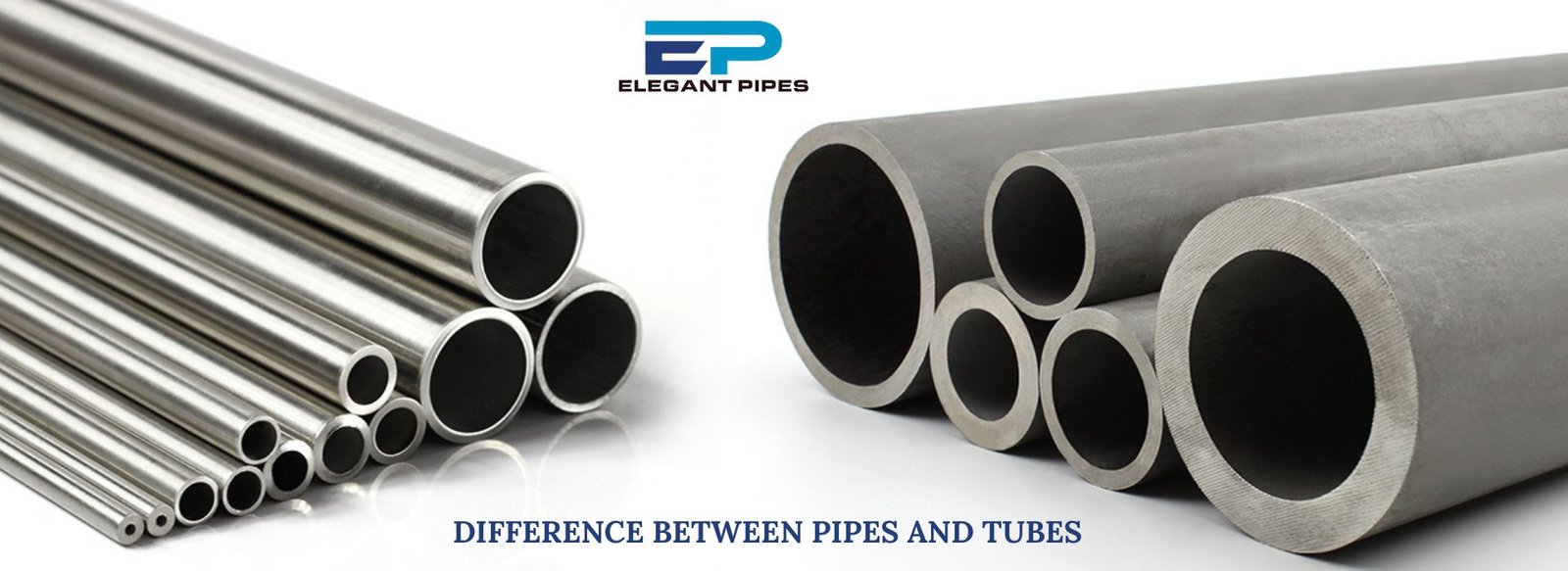
In industrial procurement and engineering documentation, the terms pipes and tubes are often assumed to be the same. In reality, there is a clear difference between pipes and tubes based on dimensions, tolerances, standards, and end-use applications.
For procurement managers, EPC contractors, and engineers working on global projects, selecting the wrong product can lead to compliance issues, installation delays, or performance failures.
As a global manufacturer and exporter, Elegant Pipes supports industrial buyers across India, the Middle East, Europe, and the USA with technically correct piping and tubing solutions.
This guide explains the technical and practical differences between pipes and tubes, with a focus on real-world industrial usage.
What Is a Pipe?
A pipe is a round, hollow product primarily used for transporting fluids or gases under pressure. Pipes are designed to move materials such as water, oil, steam, gas, and chemicals efficiently and safely.
In piping systems, the most important parameter is flow capacity, not external accuracy. That is why pipes are standardised using Nominal Bore (NB) and wall thickness schedules.
Products such as Stainless Steel Pipes and SS Seamless Pipe are commonly used in refineries, pipelines, power plants, and processing industries.
What Is a Tube?
A tube is manufactured for structural, mechanical, or precision-based applications where dimensional accuracy is critical. Tubes are used where strength, fitment, and consistency matter more than fluid flow.
Unlike pipes, tubes are measured by outside diameter (OD) and exact wall thickness. This makes them ideal for heat exchangers, structural frameworks, instrumentation lines, and mechanical components.
Industrial buyers often specify SS Tube, Stainless Steel Tube 304, or Stainless Steel Tube 316 for these applications.
Pipes vs Tubes: Key Differences at a Glance
| Basis of Comparison | Pipes | Tubes |
| Primary function | Fluid & gas transport | Structural & precision use |
| Measurement system | Nominal Bore (NB) | Outside Diameter (OD) |
| Wall thickness | Schedule-based | Exact thickness |
| Dimensional tolerance | Moderate | Tight |
| Pressure handling | High | Application-dependent |
| Customization flexibility | Limited | High |
This distinction explains why steel pipes vs steel tubes are specified differently in engineering drawings and procurement documents.
Shape, Dimensions & Customization Options
Pipes are almost always round, as round geometry supports pressure handling. Tubes, however, can be round, square, rectangular, or special shapes depending on application.
For export and EPC projects, dimensional flexibility is often required. Elegant Pipes provides customisation of pipes and tubes based on client specifications, including diameter, wall thickness, length, and surface finish.
Customisation is especially important for:
- International EPC projects
- OEM manufacturing
- Retrofit and replacement jobs
Measurement System: NB, OD, and ID Explained
The confusion between pipes and tubes often starts with measurement terminology.
Pipes are measured by nominal bore, which is a standardized reference value rather than an exact physical dimension. The outside diameter remains constant, while the inside diameter changes depending on wall thickness.
Tubes are measured by outside diameter and wall thickness, both of which are precise. The inside diameter is calculated and consistent, making tubes suitable for tight assemblies.
Understanding pipe and tube dimensions avoids mismatches during fabrication and site installation.
Tolerances and Dimensional Accuracy
Pipes are manufactured with wider tolerances because small dimensional variations do not affect fluid flow performance. Tubes, on the other hand, are produced with tight tolerances to meet mechanical and structural requirements.
This is why tubes are preferred in applications like heat exchangers and instrumentation systems, where even small deviations can affect performance.
Wall Thickness & Schedule Differences
In pipes, wall thickness is defined using schedules such as SCH 10, SCH 40, or SCH 80. A higher schedule means a thicker wall and greater pressure-handling capability.
Tubes do not use schedules. Instead, wall thickness is specified as an exact value, allowing engineers to calculate load-bearing capacity more accurately.
This difference plays a major role when choosing between SS Seamless Pipe and SS Tube for industrial use.
Strength and Pressure Performance
Pipes are designed to handle internal pressure, making them suitable for oil, gas, steam, and chemical transport. Tubes are designed for structural strength, bending resistance, and mechanical stability.
Neither is universally stronger the choice depends entirely on the application.
Manufacturing Process Differences
Both pipes and tubes can be seamless or welded, but the production focus differs.
Pipes prioritise pressure integrity and flow efficiency. Tubes undergo additional processing to achieve dimensional precision and surface quality.
These manufacturing differences influence inspection standards, certifications, and export documentation.
Industrial Applications
Pipes are commonly used in oil and gas pipelines, refineries, power plants, and chemical processing units where fluid transfer is critical.
Tubes are widely used in heat exchangers, boilers, construction frameworks, automotive systems, and precision engineering equipment.
Choosing the correct product improves system reliability and reduces lifecycle costs.
Common International Standards
Industrial buyers should always verify standards compliance. The most commonly referenced standards include:
- ASTM
- ASME
- API
- EN and DIN standards for European markets
Knowledge of ASTM pipe standards is especially important for export projects.
Stainless Steel Pipes & Tubes in Industrial Projects
Stainless steel is widely used due to its corrosion resistance and mechanical strength.
Common grades include:
- Stainless Steel Tube 304 for general industrial use
- Stainless Steel Tube 316 for corrosive environments
As a stainless steel pipes & tubes supplier and manufacturer, Elegant Pipes supports global buyers with consistent quality and export-ready documentation.
How to Choose Between Pipes and Tubes
Before finalising procurement, buyers should evaluate the application purpose, pressure conditions, dimensional accuracy requirements, and applicable standards. Structural and precision needs point towards tubes, while fluid transport systems require pipes.Correct selection ensures compliance, safety, and long-term performance.
Conclusion
Although pipes and tubes may appear similar, their differences in sizing, standards, tolerances, and applications make proper selection essential. A clear understanding of the difference between pipes and tubes helps industrial buyers ensure safety, compliance, and long-term performance.
Looking for export-quality pipes and tubes? Contact Elegant Pipes for bulk supply and international shipping.
FAQs
Q1. What is the main difference between pipes and tubes?
Answer: Pipes are used for transporting fluids and gases and are measured by nominal size, while tubes are used for structural or precision applications and are measured by exact outside diameter and wall thickness.
Q2. Are steel pipes stronger than steel tubes?
Answer: Steel pipes generally handle higher internal pressure, while steel tubes offer better dimensional accuracy and structural consistency.
Q3. Why are pipes measured by NB and tubes by OD?
Answer: Pipes use nominal bore to maintain compatibility with fittings, whereas tubes use exact OD and thickness for precision and fabrication accuracy.
Q4. Can SS Tube replace SS Pipe?
Answer: SS tubes should only replace SS pipes if pressure ratings and applicable standards permit it.
Q5. Which standards apply to pipes and tubes?
Answer: Pipes follow ASTM A106, A53, A312, and API standards, while tubes follow ASTM A213, A269, and A554 standards.
Q6. Does Elegant Pipes offer customization for pipes and tubes?
Answer: Yes. Elegant Pipes provides customization of pipes and tubes based on client specifications, including size, wall thickness, length, material grade, and applicable international standards. Custom requirements are supported for both domestic and export projects, subject to technical feasibility and compliance requirements.