


How to Choose Between SS 45 Deg. and SS 90 Deg. Elbow in Piping Systems

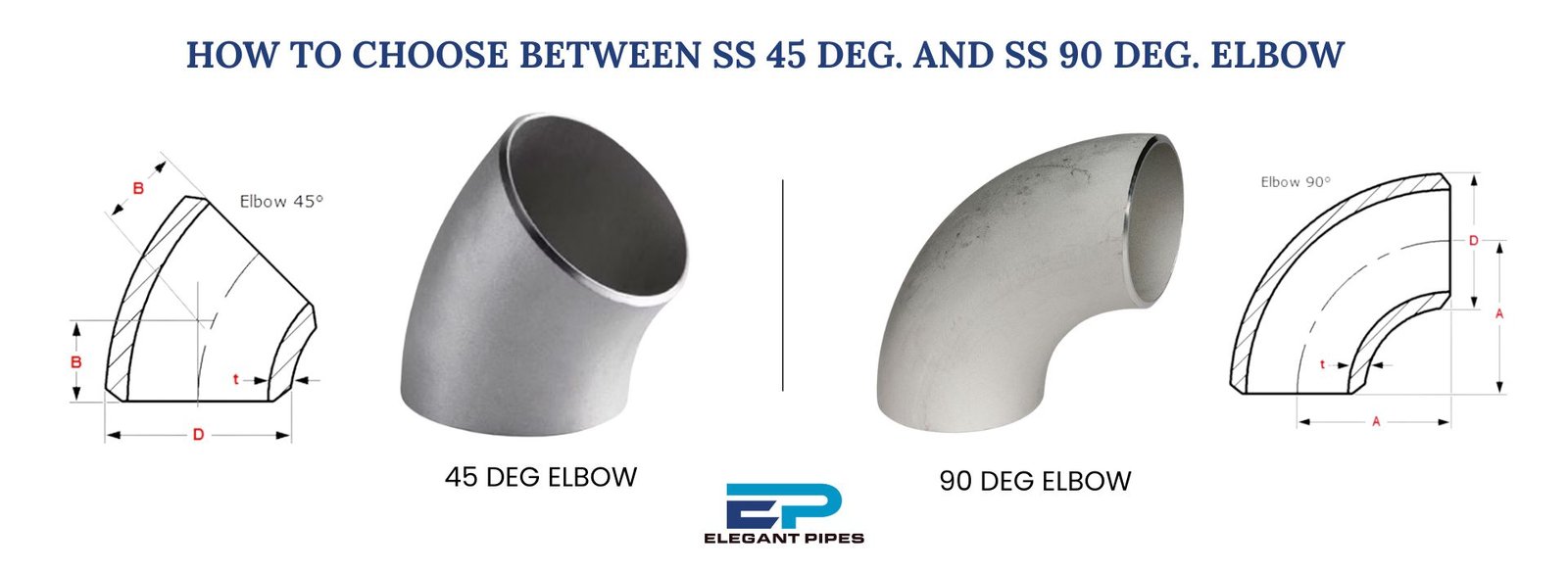
When designing an industrial pipeline, engineers and procurement managers often ask one simple but important question: Should we use an SS 45 Deg Elbow or an SS 90 Deg Elbow?
The answer depends on flow behavior, pressure drop, installation space, and system efficiency. Both fittings fall under Stainless Steel Pipe Fittings and are widely used in Stainless Steel Buttweld Fittings, but their performance differs significantly.
Let’s break this down in a practical and technical way.
What Is the Real Difference Between SS 45 Deg Elbow and SS 90 Deg Elbow?
The core difference lies in the angle of direction change inside the pipeline.
An SS 45 Deg Elbow changes the flow direction by 45 degrees, creating a smoother transition.
An SS 90 Deg Elbow changes direction by 90 degrees, creating a sharper turn.
This difference affects turbulence, pressure loss, and mechanical stress inside the piping system.
Which Elbow Causes Less Pressure Drop in a Pipeline?
This is one of the most searched technical questions.
An SS 45 Deg Elbow generally causes less pressure drop because the flow changes direction gradually.
An SS 90 Deg Elbow creates higher turbulence due to the sharper turn, leading to greater energy loss.
In high-flow or long-distance pipelines, multiple 90-degree elbows can significantly increase pumping energy requirements.
When Should You Use an SS 90 Deg Elbow Instead of a 45 Degree Elbow?
Despite higher turbulence, the SS 90 Deg Elbow is widely used in industrial piping systems.
Why?
Because it:
- Requires less installation space
- Reduces the number of fittings needed
- Simplifies pipeline routing
In compact plant layouts, especially skid-mounted systems, a 90-degree elbow is often the practical choice.
Is It Better to Use Two 45° Elbows Instead of One 90° Elbow?
Engineers frequently ask this during piping design.
Using two SS 45 Deg Elbows instead of one SS 90 Deg Elbow can:
- Reduce turbulence
- Improve flow efficiency
- Lower stress concentration
However, it:
- Requires more space
- Increases welding points
- Raises installation time
The final decision depends on whether your priority is flow efficiency or space optimization.
How Do Long Radius and Short Radius Elbows Affect Performance?
Not all elbows are the same, even within the same degree.
A Long Radius (LR) elbow has a smoother curve (1.5 × pipe diameter), which reduces friction and pressure drop.
A Short Radius (SR) elbow has a tighter curve (1 × pipe diameter), increasing turbulence.
Both SS 45 Deg Elbow and SS 90 Deg Elbow are available in LR and SR types under Buttweld Fittings standards.
Are SS 45 Deg and SS 90 Deg Elbows Part of Stainless Steel Buttweld Fittings?
Yes. Both are standard components of Stainless Steel Buttweld Fittings.
Buttweld fittings are:
- Welded directly to pipes
- Designed for high pressure
- Ideal for permanent industrial systems
They follow standards such as:
- ASME B16.9
- ASTM A403
- EN 10253
These standards ensure dimensional accuracy and structural reliability.
Which Industries Prefer SS 45 Deg Elbow Over SS 90 Deg Elbow?
Industry usage depends on operational needs.
- Chemical plants often prefer 45 degree elbows for smoother chemical flow.
- Oil & gas projects frequently use 90 degree elbows for compact layouts.
- Power plants use both depending on pressure class and design constraints.
- Marine applications rely on stainless steel pipe fittings due to corrosion resistance.
How Do Pipe Schedule and Wall Thickness Influence the Choice?
Elbows must match pipe schedule for proper strength and pressure handling.
Common schedules include:
- Schedule 10
- Schedule 40
- Schedule 80
- Schedule 160
Thicker schedules withstand higher pressure. Selecting the wrong schedule can compromise safety.
Both SS 45 Deg Elbow and SS 90 Deg Elbow are manufactured to match these schedules under global standards.
Which Option Offers Better Long-Term Durability?
Durability depends on:
- Flow velocity
- Fluid type
- Pressure
- Corrosive environment
In high-velocity slurry systems, a 45 degree elbow may last longer due to lower impact erosion.
However, properly manufactured stainless steel pipe fittings in either configuration offer excellent service life when selected correctly.
How Should You Decide Between SS 45 Deg and SS 90 Deg Elbow?
Ask yourself:
- Is minimizing pressure drop critical? → Choose SS 45 Deg Elbow
- Is space limited? → Choose SS 90 Deg Elbow
- Is flow high velocity? → Prefer smoother transition
- Is installation simplicity important? → 90 degree may be practical
In real industrial projects, both types are used strategically within the same piping system.
FAQs
1. What is the main difference between SS 45 Deg Elbow and SS 90 Deg Elbow?
The main difference is the angle of flow direction. An SS 45 Deg Elbow changes direction by 45 degrees, creating smoother flow, while an SS 90 Deg Elbow changes direction by 90 degrees, causing higher turbulence and pressure drop.
2. Which elbow causes less pressure drop in a piping system?
An SS 45 Deg Elbow generally causes less pressure drop because the fluid experiences a smoother directional change compared to a 90-degree elbow.
3. Are SS 45 Deg Elbow and SS 90 Deg Elbow part of Stainless Steel Buttweld Fittings?
Yes, both are standard components of Stainless Steel Buttweld Fittings and are manufactured according to ASME B16.9 and ASTM A403 standards.
4. When should I use an SS 90 Deg Elbow?
An SS 90 Deg Elbow is ideal when installation space is limited or when a sharp directional change is required in compact piping layouts.
5. Is it better to use two 45-degree elbows instead of one 90-degree elbow?
Using two 45 degree elbows can reduce turbulence and improve flow efficiency, but it requires more space and additional welding compared to a single 90 degree elbow.